

2026 Ford E-Transit™ near Kingsport, TN

The 2026 Ford E-Transit™ is engineered as a fully electric commercial vehicle designed to support daily business operations through consistent performance, configurable cargo capacity, and integrated digital systems. Its development focuses on delivering predictable range, optimized payload handling, and adaptable configurations that align with varied industry requirements. The model supports multiple vocational applications by combining electric efficiency with practical design elements that improve workflow and operational continuity.

Electric Powertrain and Range Efficiency
The 2026 Ford E-Transit™ utilizes a fully electric powertrain that provides smooth and consistent acceleration suitable for urban and regional driving conditions. The system is designed to maintain performance stability under varying load conditions while reducing dependency on traditional fuel sources. The absence of internal combustion components also reduces mechanical complexity, supporting operational efficiency over time.
A key feature that enhances drivability is Smart Acceleration Truncation. This system automatically adjusts acceleration output based on calculated payload weight. By moderating acceleration during initial movement, it ensures controlled starts and supports energy conservation during repeated stop-and-go cycles. This function is particularly useful in delivery routes and service operations that involve frequent stops.
The 2026 Ford E-Transit™ is configured to meet typical daily driving distances for commercial fleets. The low-roof cargo van provides an estimated driving range of up to 159 miles on a full charge. Medium-roof variants offer an estimated range of 148 miles, while high-roof configurations provide approximately 143 miles. These figures align with average daily travel requirements, allowing consistent operation without frequent charging interruptions.
Charging accessibility is supported by a front-facing charging port. This placement simplifies alignment with charging stations and improves usability in confined parking environments. The system accommodates DC fast charging, enabling reduced charging times compared to standard methods. A visible charge status indicator allows drivers to monitor charging progress directly, supporting better scheduling and route planning.
Payload Capacity and Structural Capability
The structural design of the 2026 Ford E-Transit™ supports substantial payload capacity across its configurations. The cargo van model accommodates a maximum payload of up to 3,320 pounds. Cutaway configurations extend this capability to a maximum of 4,201 pounds. These capacities enable transportation of tools, materials, and equipment across various industries without compromising vehicle balance or performance.
The chassis and suspension systems are engineered to maintain stability under load. Weight distribution is optimized to support consistent handling characteristics, even when operating near maximum payload limits. This ensures that performance remains predictable during daily use, regardless of cargo variation.
The payload system is integrated with the vehicle’s electric architecture, allowing features such as Smart Acceleration Truncation to adapt dynamically. This integration supports efficient energy use and contributes to extended operational range under load conditions.
Cargo Space Configuration and Interior Volume
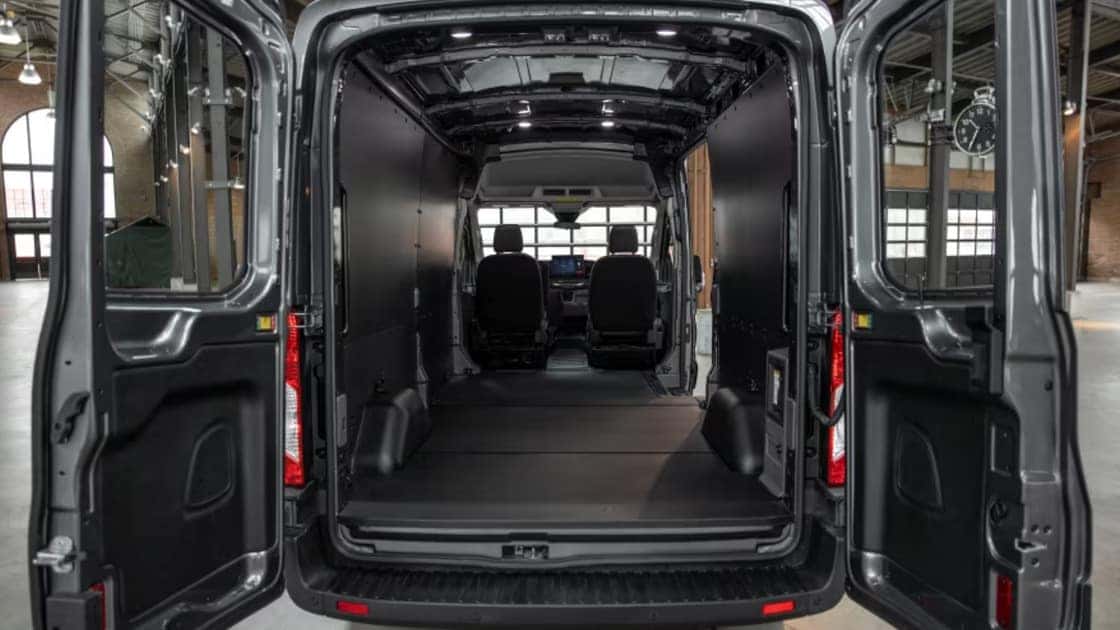
The 2026 Ford E-Transit™ provides multiple cargo space configurations designed to accommodate different operational requirements. Interior volume varies depending on roof height and body length, allowing businesses to select a configuration that aligns with cargo size and accessibility needs.
The low-roof configuration offers a maximum cargo volume of 311.9 cubic feet, with 277.7 cubic feet available behind the first row. The medium-roof configuration increases total capacity to 400.5 cubic feet, with 357.1 cubic feet behind the first row. The high-roof variant expands this capacity to 453.4 cubic feet, while the extended-length high-roof model reaches up to 536.4 cubic feet. These variations provide flexibility for transporting equipment, materials, and packaged goods.
Increased interior height in medium and high-roof models allows standing room within the cargo area. This design supports tasks that require in-vehicle movement, such as equipment organization and preparation. The interior layout is structured to maximize usable space while maintaining accessibility from multiple entry points.
Cargo management is further supported by available factory-installed packages. These configurations are designed to meet specific trade requirements, including electrical, HVAC, and general contracting applications. Each package integrates storage systems such as shelves, bins, and racks to organize tools and materials efficiently. Delivery-focused configurations include foldable shelving systems that support high-volume package handling.
Configurable Design and Functional Layout
The 2026 Ford E-Transit™ is available in eight distinct configurations, combining three roof heights, two body lengths, and multiple vehicle types. Options include cargo van, chassis cab, and cutaway models. This modular approach allows businesses to select a vehicle that aligns precisely with operational requirements without requiring aftermarket modifications.
The design emphasizes accessibility and usability. Entry points are positioned to support efficient loading and unloading, while the interior structure is optimized for space utilization. The vehicle’s dimensions are engineered to balance cargo capacity with maneuverability, allowing operation in both urban and industrial environments.
Interior seating is designed to support driver comfort during extended use. The seating system includes reclinable functionality and adjustable headrests. Durable material options, including vinyl surfaces, support long-term use in demanding conditions. For the 2026 model year, heated seats are included as a standard feature, improving usability in colder environments.
Pro Power Onboard™ and Integrated Worksite Functionality
The available Pro Power Onboard™ system adds a functional layer to the 2026 Ford E-Transit™ by enabling the vehicle to serve as a mobile power source. This system supplies electricity directly from the vehicle’s battery to external tools and equipment. It eliminates the need for separate generators, reducing equipment requirements and simplifying job site setup.
This capability is particularly relevant for trades that require powered tools in locations without immediate access to electrical infrastructure. The system supports continuous operation by allowing equipment to be powered directly from the vehicle. In addition to standard job site applications, the system can function as an auxiliary power source during emergency situations.
The integration of Pro Power Onboard™ into the vehicle’s electrical system ensures compatibility with other onboard features. This allows simultaneous use of connectivity systems, climate controls, and external power supply without disruption.
Digital Connectivity and System Integration
The 2026 Ford E-Transit™ incorporates advanced connectivity features designed to support both drivers and fleet operations. A new available 5G modem enhances data transmission speed, improving navigation performance and enabling faster access to digital resources. This system supports efficient route planning and communication during daily operations.
The available Ford Connectivity Package extends functionality by providing Wi-Fi access for up to ten devices. This feature supports mobile work environments by allowing team members to connect laptops, tablets, and other devices directly to the vehicle’s network. The package includes access to connected navigation systems, voice assistant functionality, and streaming capabilities when the vehicle is stationary.
The SYNC® 4 system serves as the central interface for vehicle controls and digital features. It includes a 12-inch touchscreen display that provides access to navigation, communication, and system settings. Voice command functionality allows drivers to interact with the system without diverting attention from driving tasks.
The Ford® App adds remote management capabilities by allowing users to monitor vehicle status and control specific functions. Drivers and fleet managers can check battery charge levels, view estimated driving range, and access remote features such as lock and unlock functions. Vehicle location tracking is also included, supporting fleet coordination and security.
Driver Assistance and Operational Safety
The 2026 Ford E-Transit™ includes a comprehensive set of driver-assistance technologies under the Ford Co-Pilot360™ system. These features are designed to support driver awareness and reduce the likelihood of collisions during operation.
Pre-Collision Assist® with Automatic Emergency Braking monitors the road ahead and applies braking if a potential collision is detected. The Lane-Keeping System helps maintain proper lane positioning by providing steering assistance when unintentional drift is detected. Auto High-Beam Headlamps adjust lighting conditions automatically, improving visibility during nighttime driving.
A rearview camera system is included to support visibility during reversing and parking. This feature is standard on most configurations and provided as a kit on chassis cab and cutaway models. These systems work together to improve situational awareness and support safer operation in various driving environments.
Intelligent Access enhances convenience by allowing drivers to lock, unlock, and start the vehicle without direct interaction with the key fob. This feature supports efficiency during frequent stops and reduces handling of physical keys.
Visit Friendship Ford of Bristol for a Test Ride
Businesses seeking an electric commercial vehicle with defined technical capabilities can evaluate the 2026 Ford E-Transit™ through a scheduled test drive at Friendship Ford of Bristol near Kingsport, TN. This opportunity allows direct assessment of acceleration behavior, cargo accessibility, and onboard systems. Observing the integration of Smart Acceleration Truncation, connectivity features, and driver-assistance technologies provides insight into daily operational benefits. Testing the Pro Power Onboard™ system and interior configurations can help determine suitability for specific work requirements. Contact our team to arrange a test ride and review available configurations in detail.
