

2026 Ford Explorer® near Kingsport, TN

The 2026 Ford Explorer® is engineered as a midsize SUV that integrates turbocharged powertrains, intelligent traction systems, modern connectivity, and flexible interior space. Its design reflects a balance of performance capability, passenger accommodation, and integrated digital systems that support modern driving needs. Ford has structured the 2026 Ford Explorer® lineup to provide strong engine output, adaptable drive modes, and advanced driver-assistance technologies while maintaining a practical three-row configuration.
This model incorporates EcoBoost® engine technology, advanced towing capability, and multiple driver-assistance features designed to assist with vehicle control, situational awareness, and travel stability. Interior technology systems extend connectivity through integrated navigation, entertainment, and wireless communication tools. Exterior design elements focus on functional lighting systems, aerodynamic structure, and trim-specific styling.
The following sections examine the vehicle’s technical specifications and integrated systems in detail, focusing on powertrain engineering, exterior design components, interior functionality, connectivity systems, and driver-assistance technologies.
Turbocharged Powertrain Engineering
The 2026 Ford Explorer® offers two EcoBoost® engine configurations designed to deliver consistent output and responsive acceleration. Both engines use turbocharging and direct fuel injection to enhance combustion efficiency and power delivery.
The standard engine across several 2026 Ford Explorer® models is a 2.3-liter EcoBoost® inline-four configuration. This engine generates 300 horsepower and 310 lb-ft of torque. The engine is standard on Active 100A, Active, ST-Line, Tremor®, and Platinum™ trims. Turbocharging increases air intake pressure, which allows the engine to produce higher power levels from a compact displacement while maintaining efficient fuel delivery.
A second engine option is available for drivers seeking increased performance output. The 3.0-liter EcoBoost® V6 engine produces 400 horsepower and 415 lb-ft of torque. This engine is standard on the ST model and available on the Tremor® model. The twin-turbocharged configuration provides stronger acceleration and improved performance when carrying heavier loads or traveling on steep grades.
Both engine options work with the traction and stability systems of the 2026 Ford Explorer® to support controlled acceleration and balanced handling. Engine power is distributed through drivetrain systems designed to maintain stability across multiple driving environments.
Adaptive Terrain Management Through Selectable Drive Modes
The 2026 Ford Explorer® includes a selectable drive mode system designed to adjust vehicle performance characteristics based on terrain conditions. Drivers can select from six available drive modes, allowing the vehicle to optimize throttle response, traction management, and transmission behavior.
The Normal mode provides balanced performance for typical driving conditions. Eco mode modifies throttle sensitivity and power delivery to promote efficient operation. Sport mode adjusts engine response and transmission behavior to prioritize acceleration and responsive handling.
Tow or Haul mode modifies drivetrain operation to support towing tasks and maintain controlled acceleration under load. Slippery mode assists traction management on surfaces that reduce tire grip. Trail or Off-Road mode, depending on the model configuration, adjusts traction and power distribution for uneven terrain.
These drive modes operate through integrated vehicle control systems that monitor wheel speed, throttle input, and traction levels. The system continuously evaluates driving conditions and adjusts vehicle responses accordingly.
Integrated Towing Systems and Stability Technologies
The 2026 Ford Explorer® incorporates towing technologies designed to support controlled hauling and maintain vehicle stability. Each 2026 Ford Explorer® model includes a standard Class III Tow Package. This equipment allows the vehicle to tow up to 5,000 pounds when properly configured.
Towing stability is supported by Trailer Sway Control. This system works alongside AdvanceTrac® with Roll Stability Control™. Sensors monitor trailer movement and vehicle dynamics. When unwanted sway is detected, the system automatically applies targeted braking adjustments and modifies engine power to stabilize the vehicle and trailer combination.
Side-Wind Stabilization assists the driver during strong or gusty wind conditions. The system evaluates lateral forces affecting the vehicle and applies corrective braking when necessary to help maintain a consistent driving path.
Blind spot monitoring technology extends to towing operations through BLIS® with Trailer Coverage. This system monitors the length of a connected trailer and alerts the driver when another vehicle enters the blind spot area alongside the trailer.
These integrated systems are designed to maintain controlled towing performance and improve driver awareness during hauling operations.
Exterior Design and Functional Lighting Systems
The exterior structure of the 2026 Ford Explorer® incorporates lighting systems, trim-specific styling elements, and functional body components that support visibility and vehicle accessibility.
The vehicle is equipped with LED headlamps that project bright and focused illumination across the roadway. LED lighting provides energy efficiency and extended service life compared with traditional halogen lighting systems. The headlamp design integrates with the vehicle’s front fascia to create a streamlined front profile.
At the rear of the vehicle, LED taillamps connect through a light bar design that extends toward the liftgate area. This configuration increases visibility for following drivers and contributes to the vehicle’s recognizable rear appearance.
Trim-specific grille designs distinguish different 2026 Ford Explorer® models. Each trim level incorporates its own grille pattern and finish to reflect its styling identity. The ST-Line and ST models emphasize sport-oriented styling elements. The Tremor® model introduces contrasting accents designed to emphasize off-road capability.
Convenience features also appear in the exterior design. An available power liftgate allows the rear cargo door to open or close using the vehicle key fob. This system assists with loading cargo when the driver’s hands are occupied.
The 2026 Ford Explorer® can also include an available panoramic fixed-glass roof equipped with a power sunshade. The glass panel allows natural light to enter the cabin, while the sunshade helps regulate interior temperature and lighting conditions.
Wheel options vary by trim level and range from 18-inch aluminum wheels to larger 21-inch configurations. Wheel finishes include sparkle silver-painted aluminum, carbonized gray-painted aluminum, ebony-painted machined aluminum, magnetite-painted aluminum, and bright machined designs with dark pockets. These wheel options support both styling variation and structural durability.
Cabin Layout and Passenger Accommodation
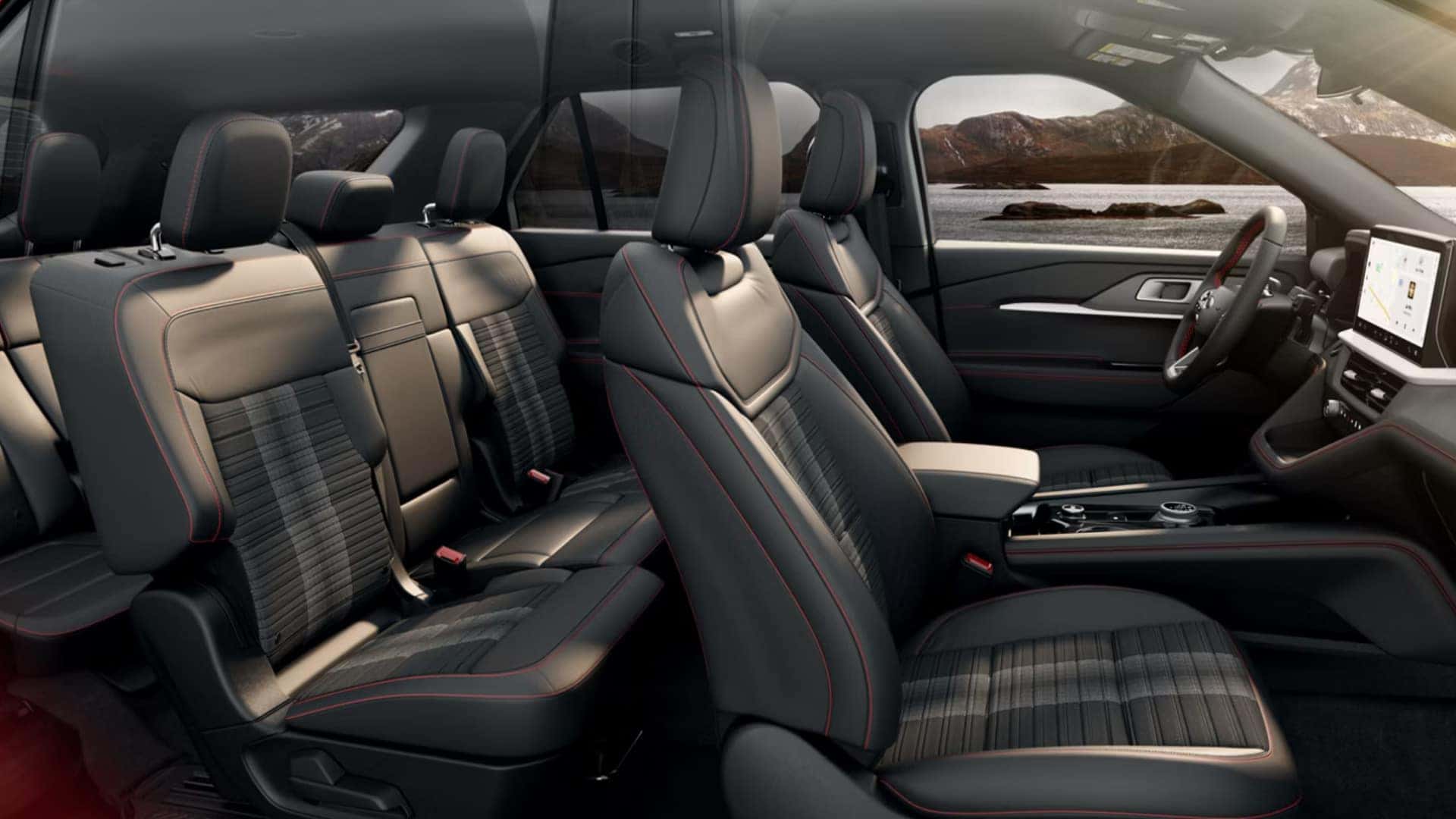
The 2026 Ford Explorer® is configured with three rows of seating and provides accommodation for up to seven passengers. The seating layout allows flexible passenger and cargo arrangements while maintaining access to the third-row seating area.
Seat materials vary across the 2026 Ford Explorer® lineup. Standard cloth upholstery provides durability for everyday use. Optional leather-trimmed seating surfaces add additional support and interior refinement. Certain models also offer multicontour seats with integrated massage functionality. These seats use adjustable air bladders to support occupant comfort during extended travel.
Interior climate comfort can be maintained through available windshield sunscreen equipment that helps reduce heat buildup inside the vehicle when parked in direct sunlight.
Passenger visibility and interior atmosphere can also be adjusted through ambient lighting systems. These lighting features allow the driver to select interior lighting colors that illuminate cabin surfaces and storage areas.
Cargo Flexibility and Interior Storage Capacity
The interior design of the 2026 Ford Explorer® supports both passenger transport and cargo storage. When rear seating is folded, the vehicle provides up to 85.8 cubic feet of cargo capacity. This storage space allows transportation of luggage, equipment, or larger items.
Certain 2026 Ford Explorer® models include PowerFold® third-row seats. These seats can be electronically folded or raised using controls located within the vehicle. This function allows quick conversion between passenger seating and cargo storage configurations.
Interior storage compartments are distributed throughout the cabin to allow passengers to organize smaller items. The vehicle’s rear cargo area can accommodate large objects while maintaining a flat load floor for easier cargo management.
Premium Audio and Interior Entertainment Systems
The 2026 Ford Explorer® supports multiple audio configurations developed in partnership with Bang and Olufsen®. These audio systems deliver enhanced sound reproduction throughout the cabin.
The first available configuration includes a ten-speaker B&O® sound system. This system distributes speakers throughout the cabin to produce balanced audio output for passengers in all seating rows.
A higher-capacity audio configuration includes a fourteen-speaker system producing 980 watts of output. This version incorporates a subwoofer and a fabric-wrapped acoustic soundbar designed to enhance sound clarity and bass response.
These audio systems integrate with the vehicle’s infotainment controls to allow passengers to manage playback through the center display interface.
Digital Connectivity and In-Vehicle Technology
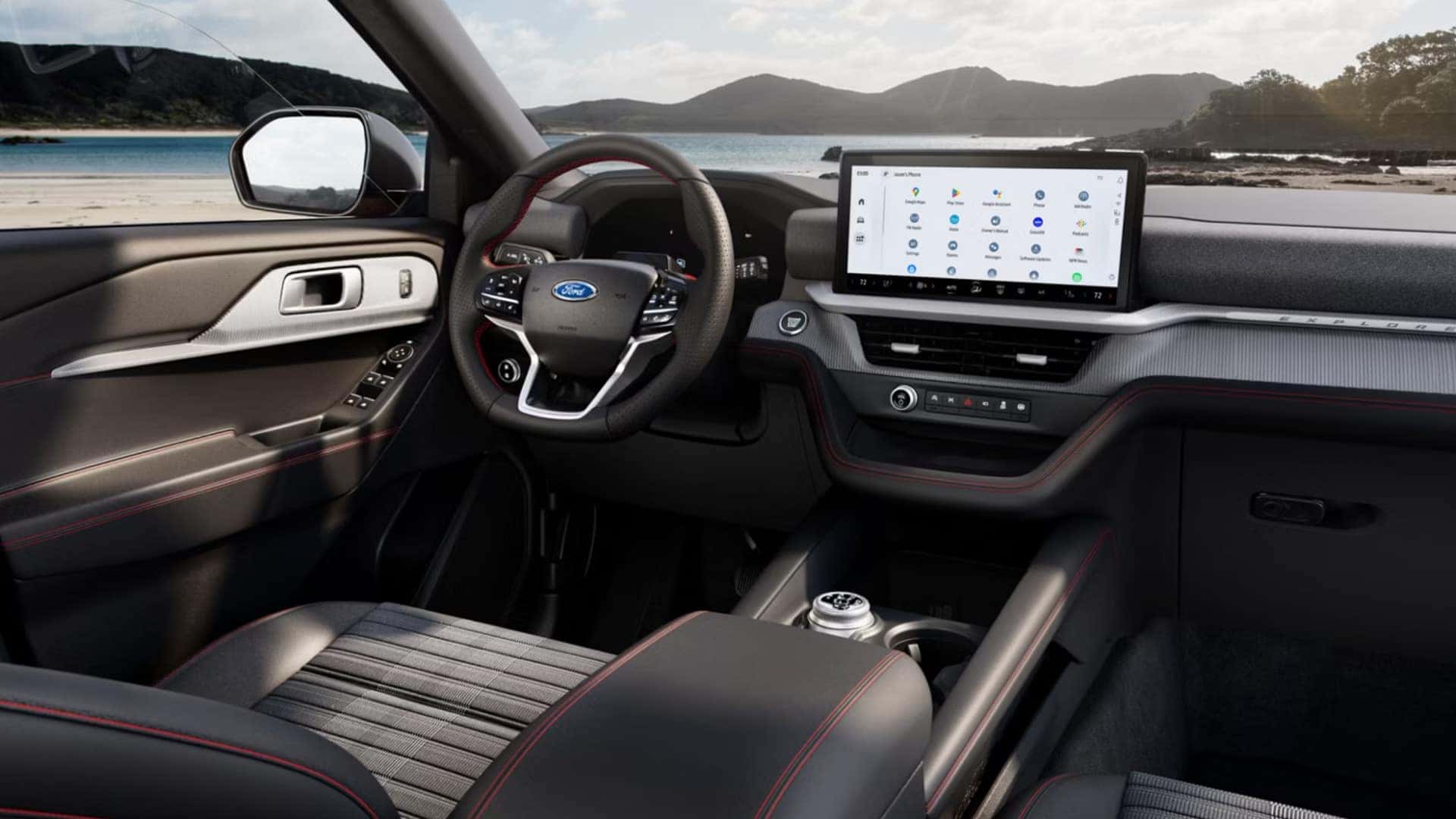
The 2026 Ford Explorer® includes integrated connectivity systems designed to support navigation, entertainment, and digital personalization. A central component of this system is the Ford Digital Experience interface.
The interface is displayed on a 13.2-inch touchscreen positioned within the vehicle’s center console area. The display presents vehicle settings, navigation tools, and application controls through an intuitive graphical interface.
Drivers can personalize the system by linking their digital accounts and configuring driver profiles. Personalization settings can include seat position adjustments, steering wheel alignment, and mirror placement. These settings can be associated with a specific key or user profile.
The Ford Connectivity Package expands digital capability within the vehicle. This package includes built-in Wi-Fi® connectivity capable of supporting up to ten connected devices. The Wi-Fi hotspot can operate within approximately fifty feet of the vehicle.
Passengers can access streaming services, podcasts, and media applications through the vehicle’s interface. Entertainment options also include karaoke features and digital games designed for use while the vehicle is parked.
Navigation support is provided through integrated Google Maps functionality. This system offers route guidance, traffic information, and navigation tools through the vehicle’s center display.
Voice commands are supported through Google Assistant integration. Drivers can request navigation directions, access information, and control media playback using spoken commands.
Additional applications can be downloaded through Google Play™ directly onto the vehicle’s system. This capability allows users to expand the vehicle’s digital functions through compatible apps.
Driver Assistance and Road Monitoring Technologies
The 2026 Ford Explorer® includes Ford Co-Pilot360™ driver-assistance technologies designed to support situational awareness and assist with vehicle control. These systems operate through cameras, radar sensors, and vehicle monitoring software.
Lane-Keeping System technology monitors lane markings and alerts the driver if the vehicle begins drifting from its lane without a turn signal. If repeated lane drift events occur, the system displays a coffee cup icon on the instrument display to suggest a driving break.
Adaptive Cruise Control with Stop-and-Go capability allows the driver to maintain a selected speed while automatically adjusting distance from the vehicle ahead. The system can reduce speed or stop the vehicle during heavy traffic conditions. When traffic resumes movement, the system can accelerate the vehicle back to the preset speed.
Lane Centering assists steering input to help keep the vehicle aligned within its lane while adaptive cruise control is active.
BLIS® with Cross-Traffic Alert uses radar sensors to monitor adjacent lanes. The system alerts the driver if another vehicle enters the blind spot area during lane changes. Cross-Traffic Alert monitors traffic approaching from the sides when the vehicle is reversing from a parking space.
These driver-assistance technologies operate together to provide additional monitoring support and driver alerts during daily driving conditions.
Visit Friendship Ford of Bristol for a Test Ride
Drivers interested in examining the engineering and technology of the 2026 Ford Explorer® can experience the vehicle directly through a scheduled test drive. Friendship Ford of Bristol near Kingsport, TN offers the opportunity to explore the vehicle’s turbocharged engine performance, selectable drive modes, and integrated driver-assistance technologies in person. A test drive allows drivers to observe the operation of the 13.2-inch touchscreen, connectivity systems, and interior seating flexibility during actual driving conditions. The experience also provides an opportunity to evaluate towing capability features and cabin technology systems. Contact our dealership to arrange a test drive appointment and review the available 2026 Ford Explorer® models currently in inventory.
